Skip to content

Stackable ballast blocks do one job: they put weight over a temporary fence foot so a line can stand on ground you are not allowed to penetrate. The step block page publishes the whole case — 295 mm high, 610 mm wide, 300 mm deep, 40–49 kg per block, concrete fill inside a coated shell, two moulded handle holes, and a stacking allowance of four high (per the product page).
That is enough to place a site. It is not enough to run a fleet. Between the last panel coming down and the first block going back out, the same figures have to survive a truck bed, a yard stack and a forklift. Here is what the published numbers cover, where they stop, and the checks that decide whether a block earns another cycle.
Key Takeaways
- The published envelope: 295 × 610 × 300 mm, 40–49 kg each, 20 blocks per package, stackable to four high, plus a stated 200 kg of added ballast per pair of fence panels (per the product page).
- Manual by design: two handle holes, two workers, no mechanical aid — so a service stack is built and pulled by hand on every turnover.
- The sheet never meets the foot: blocks sit “over the feet”, but the polymer foot page publishes a 760 × 200 × 125 mm body with Ø32 mm or Ø38 mm holes, and nothing maps the two.
- Store stacking is not service stacking: pallets come back strapped several courses deep, which is a stowage pattern, not the four-high allowance.
- Re-use fails at the shell: the coating is published as what stops the concrete cracking, so an open shell has already lost the property you bought.
What the Published Sheet Covers — and Where It Stops

| Item | As published | Where it stops |
|---|---|---|
| Size | 295 × 610 × 300 mm | No footprint matched to a foot |
| Mass | 40–49 kg, concrete-filled | A range, not a per-lot figure |
| Stack | Up to four high | Silent on blocks per post |
| Ballast | 200 kg per pair of panels | Not reconciled to block mass |
| Pack | 20 blocks per package | A buying unit, not a stowage unit |
The row that costs money is the fourth. Four blocks at 40–49 kg do not obviously produce 200 kg per pair of panels, and the page sets the two figures side by side without drawing the layout that joins them. Before you size a fleet, ask for the blocks-per-post count in writing, and for confirmation of whether 200 kg is per pair or per post.
The foot question is not a formality, because the two pages were written independently. The recyclable polymer foot publishes a 760 × 200 × 125 mm body in grey or black, a normal weight of 17 kg adjustable across 16.5–22 kg, and three groups of two Ø32 mm or Ø38 mm holes so a line can turn corners as well as run straight. The ballast block page says only that blocks are placed over temporary fence feet. A 610 mm body over a 760 mm foot is a different fit from a 610 mm body over a tube stand, and nobody should discover that in month three.
Four High Is an Allowance, Not an Answer
Stacking is the headline feature and the most misread line on the sheet. The page offers four-high stacking as the way to raise resistance to wind and to pressure from crowds, and it stays qualitative while doing it: no wind speed, no load rating and no test method appears anywhere on it. Read as an engineering limit, that is a claim the document does not support. Read as a handling limit for two people and two holes, it is exactly what it looks like.

The neighbouring claims deserve the same treatment. The foot page carries one-person-lift and wind-rating style claims, and neither page publishes what those were measured against. Ask for the basis — which tube, which panel, what spacing — before relying on either for a river flat, a trench edge or a wind funnelled between buildings.
Weight at the foot also does not do the job of bracing in the line. Ballast resists overturning at one point; the run between points is a separate problem, which is why long lines are typically stabilised at their end bays rather than weighted further — the end-bay bracing guide covers how many props a run needs. And each course is a lift-and-set by hand on every turnover, so across a perimeter that resets weekly, the stacking feature that sells the block becomes the line your crew complains about.
In the Yard: Storage Stacks Are Not Service Stacks
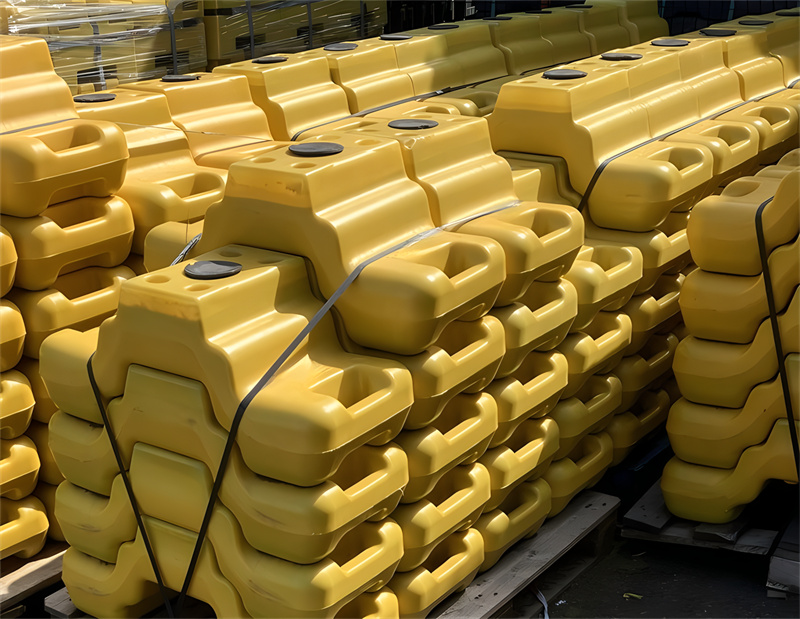
Blocks do not come home four high and stay there. A yard stack is its own problem: courses sitting on the shell of the course below, the weight of everything above landing on one bottom block, and a forklift doing the moving that the product page takes away from two workers. The foot page presents its feet as pallet-shipped for forklift movement; nothing published gives a block the same logic.
The failure is slow and unglamorous. A top block is dragged off a strapped stack instead of the strap being cut, the handle hole takes the tear, and the shell that the page presents as the thing protecting the concrete fill is open to it. The block still weighs what it weighed the day it shipped. It is still the wrong block to send back out, because a chipped, open body is precisely what the step block was invented to replace.
Six Checks Before a Block Goes Back Out
Run these at the yard gate, not on site. Each is a ten-second decision with the block on the ground.
- Shell before scale: a split coating has already failed the page’s own durability argument, whatever the block still weighs.
- Handle holes: torn or stretched moulding ends the two-worker method, and a block that needs a bar through it to be lifted is a block that gets dropped.
- Seating face: a crushed underside means the block rocks on the foot instead of loading it, and rocking chips the next edge.
- Strap condition: cut the binding, never drag against it. Slack wrap after a handful of trips stops protecting the stack it was tightened on.
- Reconciled counts: blocks issued against blocks returned, per job. A fleet that loses blocks every turnover does not have a stacking problem, it has an invisible cost line.
- Photograph the defect back: one image of the failed edge plus the job reference answers coating and fill questions far cheaper than site does.
Blocks that fail come off the fleet, and replacement timing is a planning number. This operation replies inside 24 hours, dispatches stock items in 7 days and runs 20–25 days for bulk production. The 100-panel order floor is a panel figure; nothing published here states a block minimum, so ask for one before sizing a replenishment batch against your turnover rate.
Frequently Asked Questions
How many ballast blocks go under each post?
No per-post count is published. The sheet gives a 40–49 kg block, a four-high allowance and a 200 kg figure tied to a pair of panels, without the layout joining them. Get that count in writing for your foot and your exposure.
Can a block be used without a fence foot?
The page describes blocks as placed over temporary fence feet, so a block is an addition to a footed line rather than a base in its own right. No ground-bearing figure is published either, which leaves soft or freshly graded ground an unknown until someone answers for it.
Do these blocks comply with AS 4687?
AS 4687 is the Australian standard this site cites for temporary fencing systems, and nothing on the ballast page says the block itself is tested against it. Ask which part a standards claim covers — panel, foot, or the assembled line.
Is the coating structural or only for visibility?
Both, as published: the bright yellow shell is presented as the visibility feature that reduces trips and as the layer protecting the concrete fill from cracking. Neither page gives a coating thickness, so the durability case rests on the shell being intact.
Conclusion
Ballast is one of the cheapest ways to stand a temporary fence on ground you cannot dig, and the entire business case sits in the word reusable. Weight is not where that case breaks. It breaks at the shell, at the handle hole and at the stacking habit in the yard.
Send the foot size, the site exposure and your fleet count with the enquiry, and get the blocks-per-post layout confirmed in writing before the first pallet moves. That one answer decides whether four high is a feature you use or a number you quietly stop applying after the first job.