Skip to content

An aluminium slat fence privacy run lives or dies on the gap between the boards, and the gap is where the three styles sold under the aluminium heading drift apart. DB Fencing lists slat, blade and flat-top fencing on three product pages, each with its own spacing numbers, alloy temper and warranty wording.
The numbers reward a close read. The slat page publishes gaps as tight as 15mm, the blade and flat-top pages start their published spacing at 25mm, and the slat page lists several slat widths across its sections. Before you compare quotes, read what each page publishes, because the definitions do not line up.
Key Takeaways
- The slat page publishes an 80 x 16mm slat with 15mm or 16mm gaps, the tightest clearly stated opening across the three aluminium pages.
- The blade and flat-top pages share one spec block: 65 x 16mm uprights with spacing of 85mm, 65mm, 40mm, 25mm or custom, and neither page says whether each figure is a clear gap or a centre-to-centre pitch.
- On the published 80 x 16mm slat at a 15mm gap, roughly 16 per cent of the run is open — buyer arithmetic, not a page figure.
- Spans are published too: up to 2000mm until a midrail is required and 2400mm until a full post, per the slat page’s own FAQ.
- The slat page lists alloy 6063 T5; the blade and flat-top pages list marine-grade 6063 T6. Confirm which temper is on your quote.
- Warranty wording differs: a single 10-year line on the slat page, a split 10-year powder coating and 10-year structural warranty on the other two.
Three Infill Styles, One Axis
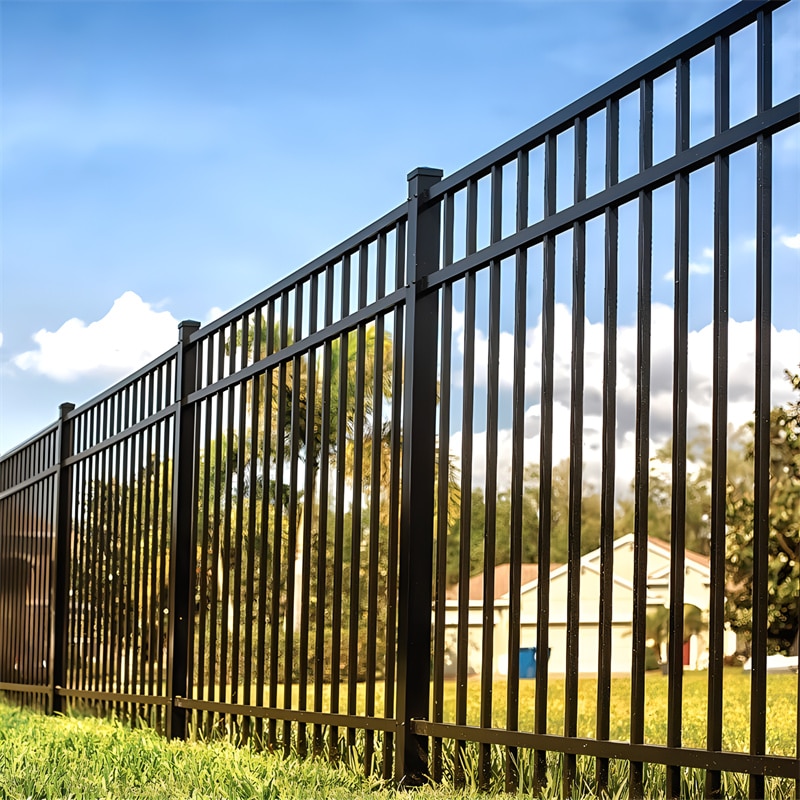
The three aluminium styles separate a run from the street in different ways. Slats run horizontally, stacked as boards with a visible slot between each row. Blades run vertically, flat faces turned to the boundary. Flat-top fencing runs vertical pickets between two rails, ringed and open enough to keep a pool or a front garden in view. What decides how much of that view survives is the width of the opening, and each page publishes that figure differently.
| Style | Infill | Published spacing | Panel sizes |
|---|---|---|---|
| Slat | Horizontal boards | 15-16mm gaps on the 80 x 16mm slat; 9mm or 20mm on other widths | 2m x 1.8m, 2m x 1.2m |
| Blade | Vertical flat blades | 85 / 65 / 40 / 25mm or custom | 2035 x 900, 2035 x 1200, 2364 x 1200mm |
| Flat-top | Vertical ringed pickets | 85 / 65 / 40 / 25mm or custom | 2035 x 900, 2035 x 1200, 2364 x 1200mm |
The slat page ships its panels with a two-piece F-channel included, and the blade and flat-top pages publish gates at 1090mm wide against 900mm and 1200mm panel heights. The variable across all three is the infill spacing; treat the table as the starting point.
What the Slat Page Publishes
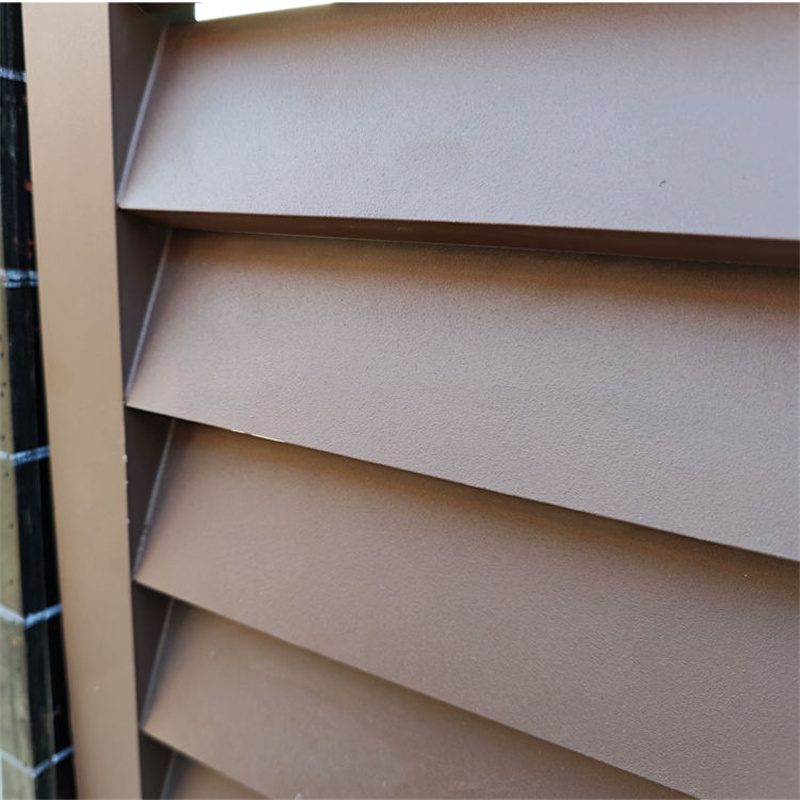
Start with the clearest row. The detailed specifications list an 80 x 16mm slat with 15mm or 16mm gaps between slats. Add the published numbers and the pitch is 95mm or 96mm, which puts the open share of the run at about 16 per cent. That is buyer arithmetic from published figures, not a percentage the page claims, and it only describes the 80 x 16mm slat. The same block then lists 75mm blades with 9mm or 20mm spacing, and 65mm and 90mm wide slats with 9mm or 20mm spacing, without repeating the words gaps between slats.
That wording matters. A 9mm figure reads tighter than a 15mm gap, but if 9mm is measured some other way the two rows are not comparable. The page’s own FAQ answers the slat width question with 65mm wide and 16mm thick, while the detail block carries 80 x 16mm slats and even 38mm and 70mm blades. Six width figures across the FAQ and the detail block is a genuine question for the supplier: ask which width and gap your run gets.
The support numbers are published plainly. The FAQ sets spans of up to 2000mm until a midrail is required and 2400mm until a full post is needed, with 44mm privacy screen posts and 50mm gate posts, and the spec block lists 50.8 x 50.8mm, 63.5 x 63.5mm and 76 x 76mm posts, in-ground or flanged. Assembly is described as a patented connection system needing no rivets, screws, nails or welding, worked with a rubber mallet and a metal cutting tool. The alloy is published as aluminium alloy 6063 T5, powder-coated or wood-grain finished in Interpon and Dulux ranges, with RAL colours available.
Blade and Flat-Top: One Shared Spec Block
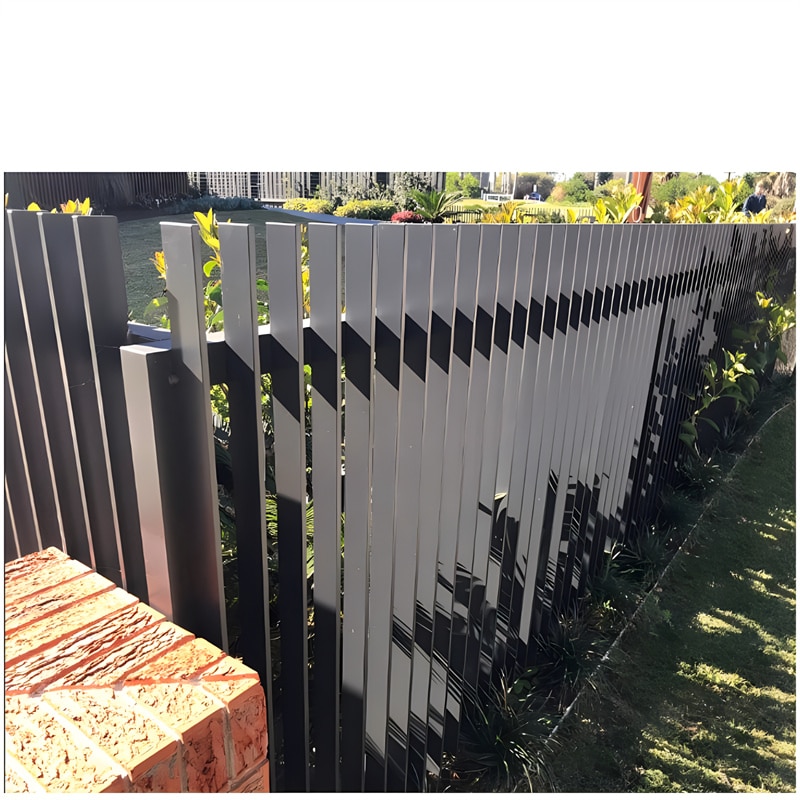
The blade page and the flat-top page publish the same specification block: marine-grade 6063 T6 alloy, powder-coated in Interpon Pearl White, on 40 x 40 x 1.6mm rails carrying 65 x 16mm uprights with a 1.2mm wall and cast caps. Spacing is listed as 85mm, 65mm, 40mm, 25mm or custom on both pages, and both describe a 6-point weld system. The panels run 2035 x 900mm, 2035 x 1200mm and 2364 x 1200mm, with gates at 1090mm wide.
The privacy reading depends on one undefined word. If 25mm is the clear gap between uprights, a blade or flat-top run is already showing more than a slat run at 15mm; if 25mm is a centre-to-centre pitch, the open slot is nearer 9mm and the comparison flips. Neither page defines the term, so the honest comparison is the one you write down after asking. The same applies to the custom option: an invitation to specify, not a published figure.
Warranty wording also differs from the slat page. Both the blade and flat-top pages back the fence with a 10-year powder coating warranty and a 10-year structural warranty covering fence, gate, screen or balustrade. Where a run mixes styles, read the two warranty structures side by side before the order is signed, and confirm in writing which applies to which line.
Choosing and Confirming
For a run where sight lines have to disappear, the published numbers point at the slat page first: 15mm or 16mm gaps on an 80 x 16mm board, on spans the page caps at 2000mm before a midrail. Blade runs suit boundaries where a screened view is enough, and the tightest published option there is the 25mm row, subject to the gap-versus-pitch question. Flat-top fencing trades density for visibility and detail, which is why the style shows up around pools and front boundaries; the slat page notes pool fencing should adhere to local safety regulations, and that confirmation sits with your local authority, not with a catalogue.
Whatever the style, the confirmations are the same five:
- Width and gap: which slat or blade width applies, and whether each spacing figure is a clear gap or a centre-to-centre pitch.
- Temper: 6063 T5 on the slat page, 6063 T6 on the other two — which one is on your quote.
- Posts: 44mm screen posts and 50mm gate posts in the FAQ against 50.8mm, 63.5mm and 76mm in the spec block, plus a 65mm post in the detail section — which applies to your run.
- Warranty: the single 10-year line or the split powder-coating and structural pair.
- Finish: Interpon, Dulux, RAL or wood grain, named on the order.
Browse the three pages — aluminium slat fencing, blade fencing and flat-top fencing — with the five confirmations open beside them, and the quote that comes back will read like the comparison table above.
Frequently Asked Questions
What is the tightest gap published for an aluminium slat fence privacy run?
The slat page publishes an 80 x 16mm slat with 15mm or 16mm gaps between slats, and lists 9mm or 20mm spacing on other widths. The 15mm gap is the tightest clearly stated figure; confirm how the other rows are measured before comparing.
What spacing do the blade and flat-top pages publish?
Both pages list 85mm, 65mm, 40mm, 25mm or custom spacing on 65 x 16mm uprights, without saying whether each figure is a clear gap or a centre-to-centre pitch. Ask which reading applies before you compare runs.
Do the three styles use the same aluminium?
The slat page lists aluminium alloy 6063 T5, while the blade and flat-top pages list marine-grade 6063 T6. Confirm which temper is written on your quote before you order.
How far can a privacy screen span without support?
The slat page’s FAQ sets spans of up to 2000mm until a midrail is required and 2400mm until a full post is needed. Keep your runs inside those limits or add the midrail or post.
Conclusion
Across the three aluminium styles, the axis that decides a privacy run is the opening, and the pages publish enough numbers to compare: 15-16mm gaps on the slat page against 25-85mm spacing on the blade and flat-top pages, under two warranty structures and two alloy tempers. What the pages leave undefined — gap versus pitch, and which slat width applies — is exactly the list to close in writing.
Send your run length, height and the five confirmations with the enquiry, and ask which readings the quote uses. The answers take one email and decide whether the run screens or only looks like it does.